National Depression Awareness Month: Recognizing the Signs and Finding the Right Treatment

With clinical insights from Luke Krupski, PA, NMOD and Medication Management Provider at Advanced Psychiatry
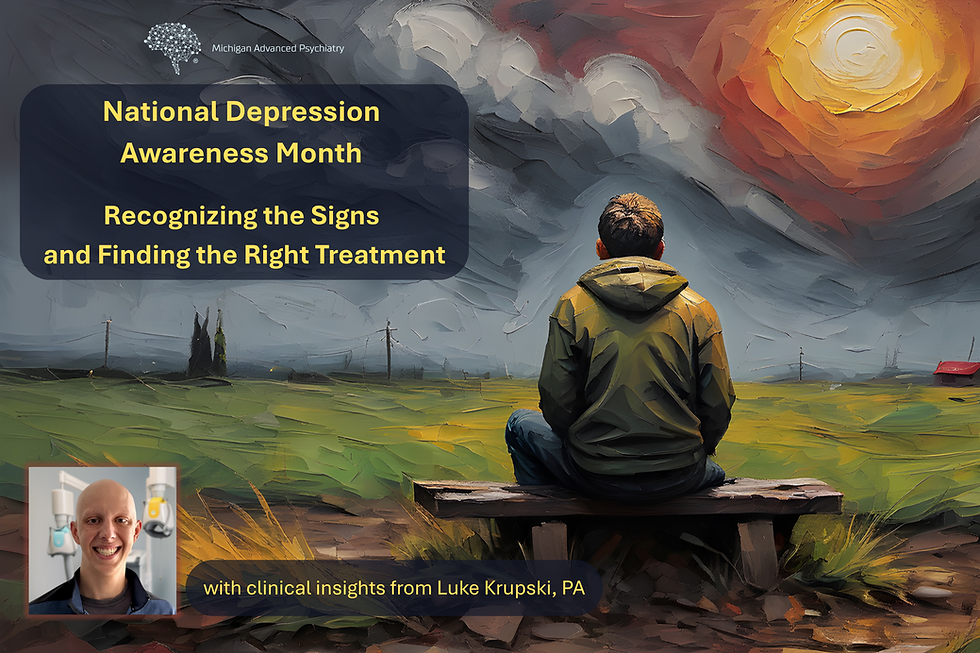
October is National Depression Awareness Month, an annual event that encourages us to look beneath the surface of a condition that affects millions of people, yet is still widely misunderstood, even by the people living with it. Depression isn’t just sadness, and it doesn’t look the same in every person it touches. It can hide behind irritability or exhaustion, and even someone who seems perfectly “fine” on the outside may be waging an internal battle.
We sat down with Luke Krupski, PA, NMOD and Medication Management Provider at Advanced Psychiatry, to talk through what depression feels like from the inside, the symptoms that often go unrecognized, how treatment works, and why there’s always another option worth exploring, even for someone who feels like they’ve tried everything.
What Depression Feels Like
To appreciate the importance of this month, we first have to understand what depression is and its symptoms. To someone who has never experienced it, depression can be easy to mistake for ordinary sadness, just a mood that should go away with a good night’s sleep, a change of scenery, or simply “snapping out of it.” But clinically speaking, depression is different. It’s not a mood that passes with a distraction or on its own. It’s a persistent, often physical weight that can make even small daily tasks like showering, answering a text, or making a meal feel disproportionately exhausting.
For many people, depression doesn’t feel like intense sadness at all. It may feel more like numbness, an internal emotional flatness where things that used to bring joy simply don’t anymore. It can also show up as a fog that makes concentration difficult, or as a persistent sense of guilt or worthlessness that has no clear cause. Depression tends to isolate a person from the inside out; even surrounded by people who care about them, someone with depression may feel completely alone, disconnected, or like a burden to everyone around them.
This is part of why depression is so often missed, by the people experiencing it and those who love them. It doesn’t always look like crying or visible despair. Sometimes it looks like someone who has simply gone quiet.
Signs and Symptoms of Depression
As mentioned, depression can look different from person to person, and many depressive symptoms don’t fit the stereotype most people picture. According to the National Institute of Mental Health (NIMH), common symptoms include:
A persistent sad, anxious, or “empty” mood
Feelings of hopelessness, guilt, or worthlessness
Loss of interest in hobbies/activities once enjoyed
Fatigue or a noticeable loss of energy
Difficulty concentrating, remembering details, or making decisions
Changes in sleep (trouble sleeping, early-morning waking, oversleeping)
Changes in appetite or weight (weight loss or gain)
Withdrawing from friends, family, or social activities
Physical aches or digestive problems that don’t have a clear medical cause
But some of the most overlooked signs of depression don’t look like sadness at all. NIMH also identifies a less-recognized set of depression symptoms that are just as significant:
Increased anger or irritability
Restlessness
Increased impulsivity or engaging in risky behavior
Increased use of alcohol or other substances as a coping mechanism
New or worsening relationship conflict
Changes in sex drive
If you notice several of these signs lasting more than two weeks, in yourself or someone you love, it may be time to talk with a professional, even if “sad” isn’t the word that comes to mind. It’s also important to note that recognizing depression for what it is only solves half the problem.
How Depression Shows Up Across Life Stages
Depression isn’t experienced the same way at every age, and recognizing how it appears across the lifespan can help both patients and loved ones catch it sooner. Symptoms vary significantly by life stage:
Children often don’t express sadness directly. Instead, depression may show up as anxiety, irritability, physical complaints like stomachaches, refusal to go to school, or increased clinginess.
Teens may show trouble at school, sullenness, frustration, and low self-esteem. They are more likely than adults to experience excessive sleepiness and increased appetite.
Young adults tend toward irritability, weight changes, oversleeping, and a persistently negative outlook, often alongside co-occurring anxiety or substance use.
Middle-aged adults often experience more frequent depressive episodes, along with symptoms like decreased libido, middle-of-the-night insomnia, and gastrointestinal issues.
Older adults may not describe feeling sad at all. Instead, depression can present as a general lack of emotion, combined with memory problems in more severe cases, which can sometimes be mistaken for normal aging or cognitive decline. Older adults, Krupski adds, “also often have complex medical conditions along with longer medication lists. It’s important to look at all aspects of their medical care and understand what may be contributing to their presentation. In doing so, we are better able to provide appropriate recommendations and treatment options.”
Gender also plays a role. Men often show depression symptoms like anger or irritability rather than visible sadness, and are more likely to use alcohol or other substances as a coping strategy, which can mask an underlying depressive episode entirely. Women, meanwhile, may experience depression tied specifically to hormonal changes, including perinatal depression (during and after pregnancy), premenstrual dysphoric disorder, and perimenopausal depression.
Recognizing these differences matters. Depression that doesn’t match the stereotype is just as real, and just as treatable, as depression that does.
For many people, the harder part comes after recognizing they may be experiencing depression: believing that something can actually help. That doubt is especially common among people who have already tried treatment before without the relief they were hoping for, and this is one of the biggest misconceptions Krupski works to correct every day.
“Treatment-Resistant” Doesn’t Mean “Out of Options”
One of the most persistent and damaging misconceptions Krupski encounters is the belief that once someone has tried a few treatments without success, they’ve essentially run out of options. “Treatment resistant does not mean there are no treatments out that could be beneficial,” he explains. “People assume that because they have tried multiple medications that continued treatment is not worth pursuing. Often, there are many treatments still on the table in the traditional sense or alternative treatments modalities that we offer.”
In other words: a few medications that didn’t work isn’t the end of the road. It’s information that helps guide what to try next.
How Treatment for Depression Comes Together
There’s no single formula for treating depression, and Krupski is clear that treatment planning starts with the individual, not a checklist. “When discussing a treatment plan with a patient, I consider all options and begin to narrow it down based on their presentation,” he says. “Often, certain treatment options are better fit than others. Through open communication we will tailor an approach that fits your treatment goals.”
Finding the right treatment starts with genuinely getting to know the person in front of him. “I find it important to not rush through the history process when discussing potential options for each person,” Krupski explains. “No two people are the same, and each treatment should be tailored for each individual. We will work together to find the right treatment for you and you will be given information to make an informed decision about your care.”
If You’re Hesitant to Seek Help for Depression
Whether it’s stigma, fear of being judged, or disappointment with a past treatment that didn’t work, hesitation is one of the biggest barriers standing between people and relief. Krupski hears this often, and his approach centers on putting the patient back in the driver’s seat. “My goal is to improve your ability to function daily … and help better guide your decisions moving forward. That may come from medication management, lifestyle changes, or alternative treatments. Ultimately, you are always the primary decision maker, and I will give recommendations based on my experience and what could be most beneficial for you.”
For those who have tried treatment before without success, he emphasizes that a disappointing outcome isn’t the end of the conversation – it’s the start of a better one. “If you have struggled with disappointment with treatment outcomes in the past, we will work to address why treatment was not successful, if it was the right treatment option, and consider alternative options moving forward.”
A Message of Hope
If there’s one thing to take from this conversation, it’s this: “Depression can be a life-altering condition that many people suffer in silence from. That said, sometimes taking the first step and reaching out for help is the most important step in the path to feeling better. Whether it’s reaching out to a psychiatric office or letting a family member know how you are feeling, your voice is the most important tool you have to the road to a better future.”
If you or someone you love is experiencing symptoms of depression, help is available, and it doesn’t require having the right words or a perfect explanation, just a willingness to reach out. Whether you’re starting for the first time or looking for a different approach after past treatment hasn’t worked, the team at Advanced Psychiatry is here to help you build a plan tailored to you. Contact us today to start on the path toward healing.
Additional Crisis Resources
988: Call or text the Suicide & Crisis Lifeline (24/7)
Text HOME to 741741: Crisis Text Line
911: For immediate emergencies
-----
Sources
National Institute of Mental Health (NIMH)